Thursday, 24 November 2016

Beavers - a biodiversity boost for Britain

credit: animalsadda.com

Beavers may be the new front line troops in the war against biodiversity loss (well, at least they may be in Scotland). 400 years after their extinction in the UK, the species has been formally recognised as nativein Scotland following a five year trial phase of reintroduction. Beavers have existed in small numbers in Scotland for a while through a mixture of legal and illegal introductions, but their official designation as native creates the opportunity for the species to grow in abundance in the UK, now being allowed to expand its range naturally – a development that has generated excitement amongst proponents of rewilding and reintroduction.

It was probably around this time last year that I first heard of the concept of rewilding and reintroduction of species. In a talk by George Monbiot echoing many of the themes in this article, I learned of the dearth of keystone species in the UK and the importance of these “ecological engineers” in creating a dynamic and diverse ecosystem, as well as their potential to conserve current species at risk. The IUCN has proposed reintroduction as a strategy for conservation since 1987 but it is with increasing knowledge of the importance of ecosystem structures that the idea is gaining traction, whereas before the decision to act on reintroduction was more political than scientific (Sarrazin & Barbault 1996). There is increasing consensus that trophic downgrading, suggested by Estes et al 2011 as the process of removing apex predators from nature, can be linked to reduced herbivore populations, influxes of disease, invasions of non-native species and the collapse of biodiversity.  Such is some of the impetus for conserving the large charismatic fauna that are at risk globally.

So this beaver news could be a positive development for biodiversity, with the Scottish Wildlife Trust (SWT) hailing it as a ‘major success story for conservation’, welcoming their constructive role in creating new wetlands that could provide habitat for many other species and coppicing woodland thereby increasing woodland diversity.

The SWT hopes that this will set a precedent for more species reintroductions. In developed countries where popular opinion is becoming increasingly geared towards the protection of nature rather than its continued exploitation, there may well be further opportunities- personally I’d love to see the lynx return to the UK. With the arguments for reintroduction set out as they are, in a time where our future conservation decisions have a lot riding on them, I think there could well be an argument for strengthening and diversifying the ecosystems we can to potentially mitigate loss through future climate change. The addition of keystone species also creates an incentive for creating protected areas, creating both economic benefits in the form of tourism and environmental benefits through the safeguarding of land from urban encroachment.

Despite this potential, research and action on rewilding and reintroduction seems to focus almost completely on the developed regions of the world such as Europe and North America, with little incentive or possibility for the expansion of species reintroduction into habitats in developing countries. Potentially the cost of such action would be too high to justify, especially where apex predators already frequently clash with the interests of agriculture and urban development. But as an action to improve the biodiversity of the United Kingdom at least, the option is there.

Thursday, 17 November 2016

The water's warm...

Tigers, rainforests, polar bears - when considering the big focuses of international conservation, I feel that marine ecosystems often get a bit left out. Since ocean biodiversity and its reaction to climate change is something I admit to knowing very little about, I thought I’d take the chance this week to delve into a different aspect of biodiversity loss.

Marine ecosystems are typically affected by anthropogenic use in more indirect ways than terrestrial systems. This year has seen the reports of increasing bleaching of coral reef ecosystems, with particularly high-profile reports that climate change had induced bleaching in coral of the Great Barrier Reef to an extent that many scientists were declaring it beyond help. Coral bleaching is no new thing – but for many ocean areas the phenomena is reaching a critical point.

What is coral bleaching? 
Stressed coral (credit: wikipedia)

Coral reefs are highly diverse, in fact containing the highest concentration of biodiversity of all marine habitats. The coral itself is host to algae called ‘zooxanthellae’, the coral’s main source of energy. Increased ocean temperatures or pollution causes the algae to leave the coral’s tissue. The result of this is coral left without its food source and more vulnerable to disease. The lack of algae also means it turns very pale or white (“bleached”). This means that coral reef ecosystems are particularly vulnerable to climate induced warming. Their death can lead to the collapse of the whole ecosystem with the many species dependent on the habitat for nutrients or shelter being thrown into peril.

Research has for several years now suggested that current warming scenarios will lead to long-term degradation of coral reefs, but the news that 25% of the Great Barrier Reef’s coral has died following a mass bleaching event shocked the world in the way that only a catastrophe in a charismatic habitat could.

Despite this, there is hope in the ability of these ecosystems to recover. A word associated with coral reefs in many publications is ‘resilience’ – the reefs themselves embody this key anthropocenic buzz word. According to Hughes et al the variability in gene flow in coral species implies a differentiating ability to result to climate change, and they suggest that rather than see a destruction of coral reefs in the future, we may well instead see a change in their structure and species composition.  Reef recovery is helped greatly by interconnection of reef ecosystems (benefits of habitat connectivity again showing up), but there is evidence that long-distance dispersal of species could also play a significant role. Crucially, coral reefs also present a case where local conservation efforts can play a large role, with the development of no-take areas already proving to help preserve fish stocks and reduce some pressure on the ecosystem under stress.

When looking into coral reef ecosystems I wasn’t expecting to come across geo-engineering solutions, but it turns out there have been suggestions of such measures  – like a ‘shade cloth’ to protect reefs from heat stress (think a giant sun umbrella), and even more drastic measures such as genetic engineering to ‘assist evolution’ of coral species.  

The topics in this blog – biodiversity loss, extinction, climate change – can seem a bit negative and depressing at times, so it’s nice to see efforts to turn the cynical news on coral reefs into something more motivating that could get people past the 'we're all doomed' state and onto practical action that can be taken to aid conservation. Whilst I am sceptical on the potential of geoengineering solutions, the sense I get from research and news media a few months on is that whilst prospects for coral reefs are dire if climate change continues at its current rate, there is potential to conserve these ecosystems if we act appropriately and allow them to recover through removing the stresses we place upon them. 

Thursday, 10 November 2016

Protected Areas: Pointless or Potential?

credit: http://henrico.us/works/engineering-environmental-services/chesapeake-bay-preservation-areas/environmental-protection-area-sign/

Today there are over 150,000 protected areas in the world, and that number is consistently growing, with designated areas of land and sea increasing in the name of conservation and preservation of habitats. The Convention on Biological Diversity's Aichi target #11 stresses the necessity of protected areas, setting out a goal of 17% of terrestrial and inland water to be designated as such. With under 4 years to go we’re currently closer to 12% but there has been considerable progress in the amount of land we are protecting from human land use.

But wait – biodiversity is decreasing, isn’t it? That is the point of this blog after all. We’re continuing to experience habitat and species loss and humans continue to occupy a large portion land surface. So is this prolific designation of protected areas actually doing anything? Or is the designation of land as 'protected' a purely descriptive act?

There is a growing sense amongst some conservationists that the use of protected areas as a strategy against biodiversity is without merit, and arguments of the ineffectiveness of individual PA are prolific. For example, habitat conversion rates in protected areas of South Asia are almost identical to unprotected areas. Despite a classification that seems to be all encompassing and binding, the systems inside many of these areas have continued to be modified, and are therefore not the pristine, natural systems that we would like. Potentially this is an issue of poor governance – the effectiveness of a protected area is surely in great part down to the people who manage it and the strategies in place to secure proper use of the area and ensure concerted effort from all stakeholders. Aichi Target 11 aims for “effective and equitable management”, but the historic failures of conservation will remind us that this is something that requires much work and state support.

With all this, protected areas seem a bit pointless. But it’s important to consider that there are successes – but this success is variable and dependent on a number of factors. Another key issue to consider with protected areas is the health of what is effectively left behind. As Laurence et al. set out, it has been noted that the neighbouring area immediately outside the designated area is frequently more degraded than the protected area may have been had it not been. This points to the importance of habitat connectivity – with large, interlinked areas providing greater benefit than separate smaller areas.
The hope for protected areas, I think, lies in connectivity – something that has been readily taken up by conservation organisations such as Panthera, whose Jaguar Corridor Initiative has tried to provide links between patches of forest in Costa Rica to enable jaguars to move around the country, and is beginning to see positive results in the numbers of jaguars present and the health of individuals.

So if connectivity is key, then maybe larger protected areas are the answer? In the last few weeks the Ross Sea in Antarctica joined the growing list of marine protected areas, becoming the largest of its kind at almost 1.57 million km2 and containing a no-take zone that prohibits commercial fishing in the area for 35 years in an attempt to conserve the ecosystem and its inhabitants. Of course, we’re yet to see the results of this designation and it is too early to tell whether the action will be positively enforced, but I can’t help being more hopeful for this protected area, one that provides a large, connected area for the wildlife it contains to move about in at their will, potentially removing one of the common limitations of marine protected areas as being unable to encompass migrating species. As noted in the BBC article linked, “Some countries are concerned that a marine protected area in the high seas around Antarctica would set a precedent for the rest of the world”. Maybe we should hope that it does.

Wednesday, 2 November 2016

Learning from the past: adventures in paleo

“Without consideration of the time perspective available from the geological record, a full evaluation of the contemporary extinction problem may prove as difficult as would be the case…if an epidemiologist were to treat an infectious disease without medical records” 
(Raup, 1988, quoted in Myers, 1990)

As I’ve mentioned before, there is a consensus amongst many scientists today that we are in the early stages of a new mass extinction which unprecedented in some ways (mainly its principle cause) but preceded by 5 other mass extinctions in geological history, which as the quote above illustrates, could enlighten this situation for us.

Conservation tends to focus on the future on questions of how we can preserve species and habitats for subsequent generations, but many scientists propose that we are in the eye of the storm of biodiversity loss and therefore looking at paleoenivronmental studies offers us a long term view and a record of previous climate changes. Looking at the past may be just as important as the future. Studies further suggest that there could will be similarities between the current extinction episodes and previous ones – such as a preferential loss of endemic species and higher vulnerability of habitats in the tropics (Myers, 1990).

There are 4 key things we can learn from paleoenvironmental studies…
  1. Extinctions are not unprecedented – as Jablonski (2001) states, one of the key things that can be taken from previous events is that mass extinctions happen – species and ecosystems are not resilient forever and they are not immune to change. Over 90% of all species that have ever walked the earth are currently extinct. Fossil records reveal previous climate change events have occurred and ecosystems have persisted and adapted to this (Jablonski, 2004)
  2. Ecosystems have the power to recover – each past mass extinction has been followed by a period of recovery in which new species have evolved at a rapid rate. The disruptive processes driving extinction could also act as creative ones and lead to speciation (Myers 1990). Despite this hopeful prospect, it’s important to remember that it’s extremely difficult to accurately predict the evolutionary response of species and any such process will undoubtedly be a slow one, and may not be able to keep up with human intervention (Jablonski 2001).
  3. Extinctions may not happen the way we expect – Past events have shown that the likelihood of a species surviving is not necessarily linked to its success during periods of low extinction rates (‘background’ periods). Therefore we won’t necessarily know which species are at highest risk from loss, stressing the importance of consistent global conservation efforts (Jablonski 2001; Myers, 1990).
  4. The past can help to inform present conservation – Whist point 3 may seem to make the task of conservation impossible, there is evidence that can be taken from past extinctions to aid efforts. Past extinctions provide examples of how species have been able to adapt to prior climate events and therefore offer tips on how we can help current species to adapt. They also offer some words of caution for present-day conservation practitioners – endemic species suffered the greatest during the Cretaceous-Tertiary mass extinction (Myers, 1990), so this emphasises the attention they need in conservation efforts. Fossil pollen records show changes in forest range shifts and the joining and splitting up of forest communities, indicating a potential for movement, but Petit (2008) states that records imply that today’s trees won’t have the ability to migrate in time with future rapid warming. Petit further suggests tree species therefore may need a helping hand in the form of ‘assisted migration’ – perhaps we should be acting on this and starting to aid tree species to mitigate against warmer conditions through actively creating plantations in areas predicted to move into a suitable climate.
Of course, there remains the critical issue that the 6th mass extinction will be unprecedented due to the major impact of homo sapiens, so prediction will remain tricky. But paleo studies may push us closer to being able to make informed decisions in conservation.

Thursday, 27 October 2016

Hot off the press: The 2016 Living Planet Report

Today marked the release of the latest Living Planet report by the Zoological Society of London (ZSL) and the World Wildlife Federation (WWF), a leading publication setting out the current state of biodiversity. To be honest, I was a little surprised this morning when I had to navigate to the ‘science’ section of the BBC website – I had expected it to be front page news but then again, it was the Bake-off final last night.

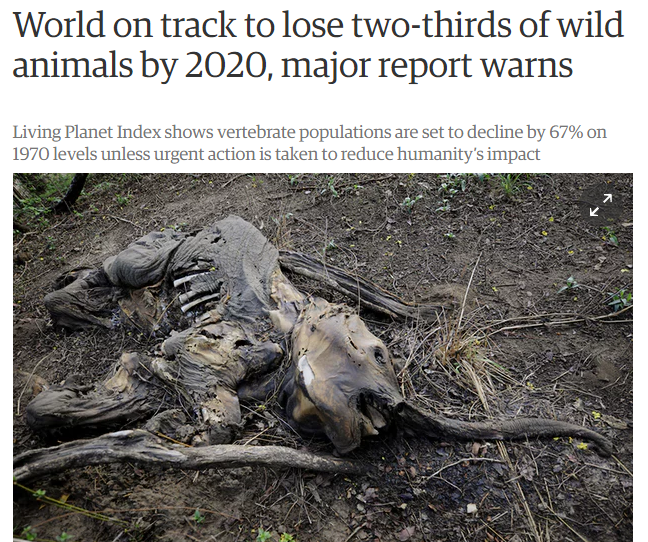
The headlines I did find paint a largely negative picture and sum up a the report’s findings with the major theme as loss – it’s a damning and shocking report spelling out in no uncertain terms that species are continuing to disappear at a rapid rate and its results only extend the trend from the 2014 edition that I mentioned in the first post on this blog of major species decline. The trend, however, has worsened – now stating a decrease in species abundance of 58% between 1970 and 2012, increased this time in great part due to a more informed consideration of freshwater species. The big statistic that most outlets have grabbed hold of is a predicted loss in species populations of 67% by 2020 (measured against the levels of 1970). Considering that one of the thresholds for a mass extinction is the loss of 75% of species (Barnosky et al, 2011) it appears that the 6th mass extinction event could be with us faster than expected.  


The Guardian's headline today


Something that becomes clear from the start of reading is that this edition is structured around two of the big conservation buzz words of the moment – ‘Anthropocene’ and ‘Resilience’, with the Anthropocene as the ‘defining concept’ in this year’s report. For me, it seems that the Anthropocene has become one of the ‘defining concepts’ of my degree as well – over the course of the last two years or so I feel like I’ve witnessed a change from being introduced to it as a proposed term starting to gain traction in the academic world, to being included as a key term in an international publication such as this one which cites the ideas of Crutzen and Stoermer (2000) and Steffen at al. (2007 and 2015) as key starting points for their report. The focus on the Anthropocene is the report taking the stance that the human race has triggered this biodiversity crisis. 

If ‘Anthropocene’ is the bad news, then ‘Resilience’ seems to be the good – it’s portrayed by the report as the way in which we can halt the negative trajectories and become more sustainable for the benefit of our societies, the environment and wildlife, the goal being a ‘transformation’ to a resilient planet. Contrary to laying out the loss of species to simply shock people, the report seems to be taking the approach of "well here's the science, now let's act on it". According to the WWF, being resilient involves three goals that will result from ‘better choices’ – biodiversity conservation, ecosystem integrity and food, water and energy security; the report combines these in a way which intrinsically links the future of the human species with that of the biosphere, echoing the planetary boundaries concept. The message from this is clear – becoming resilient to the socio-economic effects of food, water and energy insecurity requires a more environmentalist approach; to solve our problems we must also solve the ones that we have placed upon the environment. 

What I take from this report is yet another move towards the agreement that human activity is responsible for the biodiversity crisis, and a message that urgent action needs to be taken to enforce a shift to a more sustainable planet. Whether this will help towards halting biodiversity loss, however, is another thing. 

Wednesday, 19 October 2016

First post

Welcome to the blog!

Something that has interested me throughout my undergraduate studies is the concept of biodiversity – its global patterns and how we can track its changes, the way that species interact in a complex ecosystem, and what we can do to ultimately stop the unnecessary loss of biodiversity attributed to human action (I know, a bit idealistic perhaps).

We may be in what the Convention of Biological Diversity (CBD) is calling the ‘Decade on diversity’ but statistics seem to be pointing to anything but, with wildlife suffering more than ever from human activity. The CBD’s Aichi targets of 20 actions to be achieved by just over 3 years’ time set out desirable, but in my opinion unrealistic, goals to improve sustainability and prevent action that is leading to biodiversity loss. There is motivation to save biodiversity, but I’m sceptical as to whether this is something that can be achieved under current climate change predictions.

As reported in the 2014 Living Planet Report, populations of vertebrate species have decreased by a staggering 52% in the last 40 years with freshwater species declining at an even more drastic 76%. Trends show little sign of slowing, the last 10 years causing us to say goodbye to 2 million km2 of forest land (Hansen et al, 2013). So there can be little doubt that a drastic change is taking place.

credit


Mass extinctions (a loss of more than ¾ of species in a short (at least geologically speaking) time period) are nothing new in the Earth’s history – we’ve had 5 with the most recent finishing approximately 65,000,000 years ago. But studies such as Barnosky et al 2011 suggest that we are experiencing a 6th, with species losses at a higher rate than they should be according to fossil data. As Barnosky et al. discuss, extinction is no big deal in the grand scheme of things, except for when it happens as rapidly and at such a high level as it is today. We are drastically changing the environment at a rate that precludes the potential for species to recover, evolve and keep up with the changes in climate.

Hopefully, this blog will manage to explore these concepts in more depth and look at what the future prospects are for global biodiversity and answer some questions that have been playing on my mind for a while – how likely is it that we can slow down the rate of biodiversity loss and extinction, and what exactly will the consequences be if we don’t?